
The first question almost every new osek patur has is which document to actually send a customer. The answer is short, and it isn't the one most people expect: not a tax invoice.
Two documents, two events
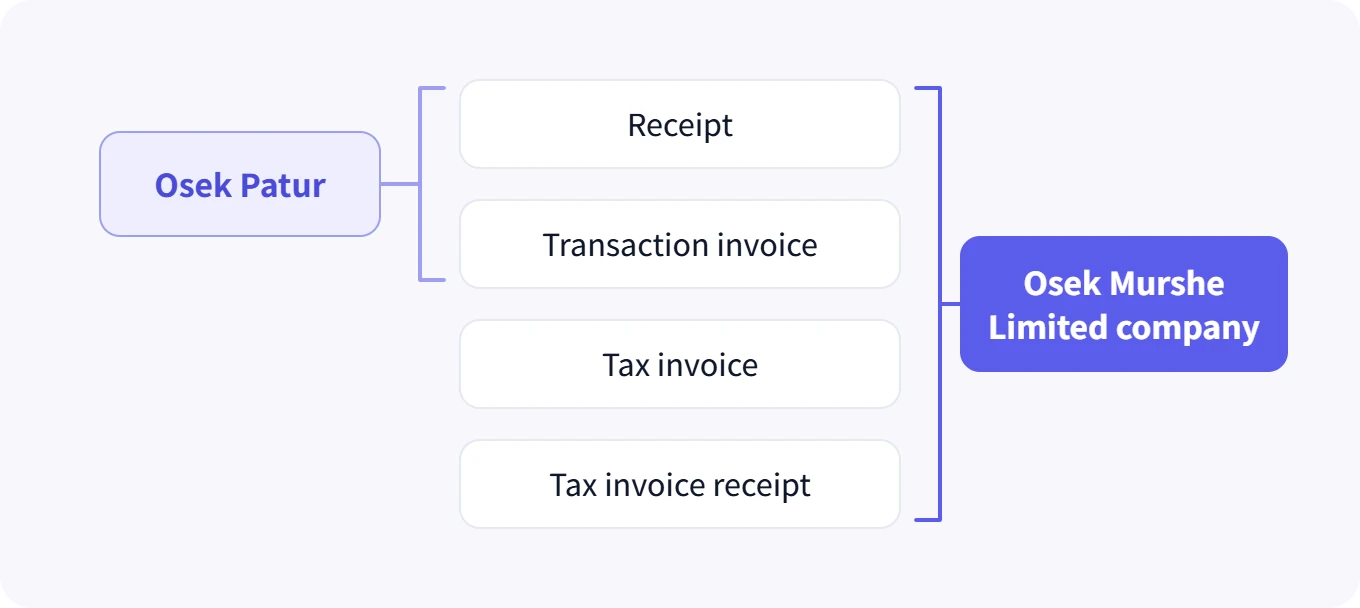
An osek patur issues a transaction invoice for the sale, and a receipt for the money that came in. These record two different things, and even when issued in the same minute they stay separate in numbering and in the books.
- Transaction invoiceWhen the sale is agreed and payment is due. Records what was sold and for how much
- ReceiptWhen the money actually arrives. Records how much was paid and by what method
Why a tax invoice is off-limits here
A tax invoice isn't just a different name for the same piece of paper. It's the document that lets a business customer deduct the VAT charged to them as input VAT. Since an osek patur never charged VAT in the first place, there's no amount for the customer to deduct, and the document would represent a deduction with nothing behind it.
That's why this is a prohibition rather than a preference. The full comparison between document types is in the tax invoice, transaction invoice and receipt guide, and the background on the status itself is in the osek patur guide.
What has to be on the document
- Business name and dealer number
- Wording identifying the document type: transaction invoice or receipt
- A running serial number, unique per document type
- Issue date
- Customer name, plus dealer number or ID for a business customer
- Description of the goods or service sold
- The amount, and on a receipt also the payment method
What's absent matters just as much: no VAT line, no VAT rate, and no split between a pre-VAT amount and a total. The amount shown is the amount, full stop. A template copied from an osek murshe with a leftover "VAT 0%" row produces exactly the confusion that makes customers ask for a tax invoice.
On a receipt, add the payment instrument details: cash, transfer, cheque number and bank, or the last four digits of the card.
When a customer demands a tax invoice
This happens to nearly every osek patur, usually from a bookkeeper used to receiving tax invoices from everyone.
What's worth saying: the transaction invoice you received is full documentation of the expense for income tax. It goes into the books, it reduces taxable income, and it's recognized like any other expense. The only thing it can't do is support a VAT deduction, not because the document is deficient, but because no VAT was ever charged. The customer didn't pay VAT, so there's nothing to claim back.
If the customer still won't budge, what they're really asking is for you to be an osek murshe. That's a legitimate reason to consider a voluntary switch, especially when most of your customers are businesses.
Allocation numbers: never, at any amount
The allocation number requirement covers tax invoices and tax invoice receipts. An osek patur issues neither, so the requirement doesn't reach them even on an ILS 50,000 sale.
That's worth stating outright, because the reform got enough coverage that osek patur businesses assume they need to connect to the Tax Authority's system. They don't.
Numbering, retention and signing
Numbering must be running and sequential per document type. Transaction invoices in one series, receipts in another. A number that breaks, skips or repeats is exactly what an audit looks for, and it can't be quietly fixed after the fact.
An issued document is never deleted or edited. A correction is made by issuing a cancelling or replacement document, depending on the case. Everything is kept for seven years under the retention rules, in a state where it can actually be produced.
A computer-generated document also needs a digital signature proving it hasn't been altered since issue. A Word or Excel file can't produce one on its own.
What happens when you become an osek murshe
The day you switch, the document set changes: instead of a transaction invoice you issue a tax invoice, and VAT plus a periodic report come with it.
The old series aren't deleted and don't reset retroactively. The transaction invoices you issued stay as they are, and the new series starts alongside them. The process is covered in the transition guide.
A transaction invoice with no VAT line
Business type is set in the business settings, and Slate offers only the document types that status permits. For an osek patur there's simply no tax invoice option, no VAT field on the document, and numbering is kept separately per type. You can issue a transaction invoice for free and see the finished document before signing up, or open a sample transaction invoice as a PDF.
This is general information, not tax advice. For a specific case, consult an accountant or tax adviser.
Common questions
Which invoice does an osek patur issue?
A transaction invoice for the sale itself, and a separate receipt for the payment actually received. An osek patur may not issue a tax invoice.
Why can't an osek patur issue a tax invoice?
A tax invoice is the document that entitles the customer to deduct input VAT. An osek patur charges no VAT, so there is nothing for the customer to deduct, and issuing one breaches the VAT regulations.
What has to appear on an osek patur invoice?
Business name and dealer number, wording identifying the document type, a running serial number, issue date, customer details, a description of the goods or service, and the amount. No VAT line, and no split between a pre-VAT and a VAT-inclusive amount.
A customer is demanding a tax invoice. What do I do?
Explain that your status doesn't allow it. A transaction invoice from an osek patur is full documentation of the expense for income tax purposes. The only thing the customer can't do is deduct VAT, because no VAT was ever charged to them.
Does an osek patur need an allocation number for a large invoice?
No, at any amount. The allocation number requirement applies to tax invoices and tax invoice receipts only, and an osek patur issues neither.
Can the transaction invoice and receipt be one document?
They record two separate events: the invoice records the sale, the receipt records the payment. When payment arrives at the time of sale it's common to issue both together, but they remain two documents with separate numbering.