
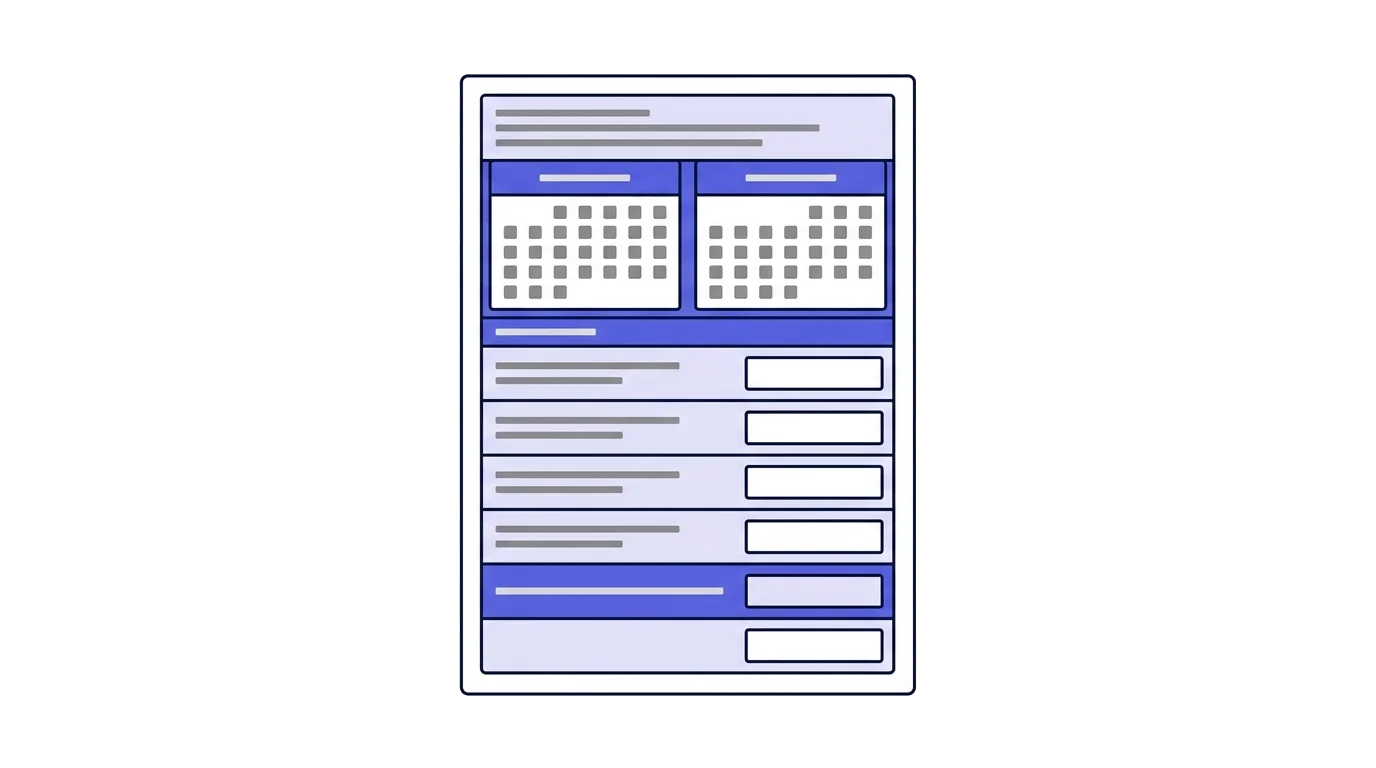
The periodic VAT report is the recurring filing every licensed dealer and company submits to the Israel Tax Authority, and it's also what determines the actual VAT payment or refund.
- The VAT you charged customers during the period
- Every tax invoice you issued
- Including invoices not yet paid
- The VAT you paid on allowable expenses
- Deductible only for a licensed dealer
- Some expenses, such as a car, only in part
Who has to file this
The obligation applies to a licensed dealer (osek murshe) and to a company. An exempt dealer charges no VAT and files no periodic VAT report at all, though they do file an annual turnover declaration.
This report is entirely separate from income tax advances, which are a percentage of turnover reported to income tax, and from national insurance contributions, which are calculated on taxable income. The same business reports three different numbers to three places.
What goes into the report
At its core, the report is a simple equation:
Output VAT − input VAT = VAT payable (or refundable, if the result is negative)
Output VAT is the total VAT you charged customers on tax invoices issued during the period. Input VAT is the total VAT you paid on deductible business expenses, which can only be deducted by a licensed dealer.
If your input VAT is higher than your output VAT, for example in a month with a large equipment purchase, the Tax Authority owes you a refund.
Not every shekel of VAT paid enters the input side. The conditions for deducting, the six-month window, mixed inputs and the split between equipment inputs and other inputs are covered in the input VAT guide.
By issue date, and what sets it
A tax invoice enters the report for the period in which it was issued. The interesting question is when you may and must issue it, and that follows the tax point.
For most service providers the tax point is receipt of payment, on the amount actually received. The invoice goes out when the money arrives, and the VAT lands in that period. To ask for payment earlier you send a transaction invoice, which creates no VAT liability.
On the accrual basis it works the other way, which is the position for goods and for service providers with high turnover. There the invoice goes out with the transaction, and you remit VAT that has not reached your account yet. In a business with long payment terms that is a real cash-flow effect, so confirm with your accountant which basis you report on before planning around it.
A worked example
A month with three tax invoices totalling ILS 40,000 before VAT produces ILS 7,200 of output VAT. In the same month, deductible expenses of ILS 12,000 before VAT were recorded, meaning ILS 2,160 of input VAT. The result: ILS 5,040 payable.
If that month also included an equipment purchase of ILS 30,000 before VAT, input VAT rises by ILS 5,400 and the report turns into a refund of ILS 360. The VAT calculator handles the before-VAT and including-VAT split.
How filing actually works
Filing is done online through the personal area on the Tax Authority website; for most businesses there is no paper route. You log in, enter the amounts in their fields, and pay on the same screen or by separate transfer. Anyone represented by an accountant or tax adviser files through them, and the filing is recorded in the representative's name.
Businesses above a certain turnover have to file the detailed report, a PCN874 file listing each invoice separately instead of aggregate sums. The file is produced by your system and uploaded, and it is what lets the Tax Authority cross-check the invoice you reported against the one the other side reported. A mismatch between the two is one of the most common reasons they get in touch.
What to do with credit notes
A credit note issued during the period reduces that period's output VAT, even if the invoice it cancels belongs to an earlier period. There's no need to amend a report already filed.
How often you file
The frequency, monthly or bimonthly, is set by the Tax Authority based on the business's turnover, and it's stated on your file-opening confirmation. You can't choose a frequency on your own; changing it has to go through the Tax Authority directly.
This report is one of several running in parallel, and the whole reporting calendar is collected in the bookkeeping for the self-employed guide.
The filing deadline
The report is due by a fixed date each month or every two months (usually the 15th of the month following the reporting period, pushed back around holidays). Filing late triggers a fixed late-payment fine that grows over time, even if there's no actual VAT owed.
Keep two dates apart: the filing date and the payment date. Paying late adds linkage differences and interest on top of the fine for filing late.
What happens if you forget to file
The filing requirement holds even for a period with no income at all, filed as a "zero" report. The Tax Authority doesn't close your file automatically, and it keeps expecting regular reports until the file is formally closed.
A pile-up of unfiled reports can lead to a best-judgment assessment, meaning the Tax Authority's estimate replaces your figures. Fixing that after the fact always costs more than filing a zero report on time.
Amended reports, when a mistake surfaces
A mistake in a report already filed is corrected through an amended report for that period, not through a quiet offset in the next one. The distinction matters: rolling a small difference into the next period is common practice in small businesses, but a material correction, and any correction that lowers the liability, has to be made openly.
The reason is simple. The detailed report cross-checks invoice against invoice, and a gap closed quietly in a different period reads to the system as two mismatches instead of one.
VAT refunds, and what holds them up
When input VAT exceeds output VAT, the difference is refunded to the bank account registered on the file. That is a normal position for a business that bought equipment, for a business in its first year, and for a business whose customers are all abroad and whose sales are therefore zero-rated.
What holds a refund up: a bank account that was never updated, earlier reports left unfiled, and an amount out of line with the business's own history, which can trigger a review before payment. A review asks for the invoices behind the input VAT, so they are worth keeping ordered rather than scattered across email.
Making sure the numbers are right before you file
- Every tax invoice issued during the period is included in full, even ones that haven't been paid yet.
- Expenses marked as deductible for VAT match the rules (some, like car expenses, are only deductible in part).
- No expense has accidentally been recorded twice.
- Supplier invoices above the threshold carry an allocation number, without which their input VAT isn't deductible.
- The period's credit notes are reflected on the output side.
The report calculated from documents already issued
Slate calculates the VAT report directly from the documents and expenses already entered in the system. The exact same calculation shown on the report screen also powers the AI assistant when you ask something like "how much VAT do I owe this month," so the two can never disagree.
This is general information, not tax advice. For a specific situation, talk to an accountant or tax adviser.
Common questions
When is the VAT report due?
By the 15th of the month following the reporting period, monthly or bimonthly, as the Tax Authority has set for the business. When the 15th falls on a Saturday or a holiday the date moves, and certain online payment methods sometimes buy a couple of extra days.
Does an osek patur file a periodic VAT report?
No. An exempt dealer charges no VAT and files no periodic report. They file an annual turnover declaration instead, by 31 January for the year that ended.
Do I have to file in a month with no income?
Yes. A period with no activity gets a zero report. Not filing carries a fine even where nothing is owed, and a run of missing reports can lead to a best-judgment assessment.
Does an invoice enter the report when issued or when paid?
By its issue date, and when you issue depends on your reporting basis. For most service providers the tax point is receipt of payment, so the invoice goes out with the money and lands in that period. A business on the accrual basis puts an issued invoice in the report even if the customer pays in 90 days.
What do I do about a mistake in a report already filed?
File an amended report for that period. A small correction in the Tax Authority's favor can sometimes be rolled into the next period, but a material one, and any correction that lowers the liability, goes through an amended report rather than a quiet offset.
When does a VAT refund arrive?
When input VAT exceeds output VAT, the difference is refunded to the bank account on file. Large or unusual refunds may be reviewed before payment, so the invoices behind the input VAT are worth having to hand.