
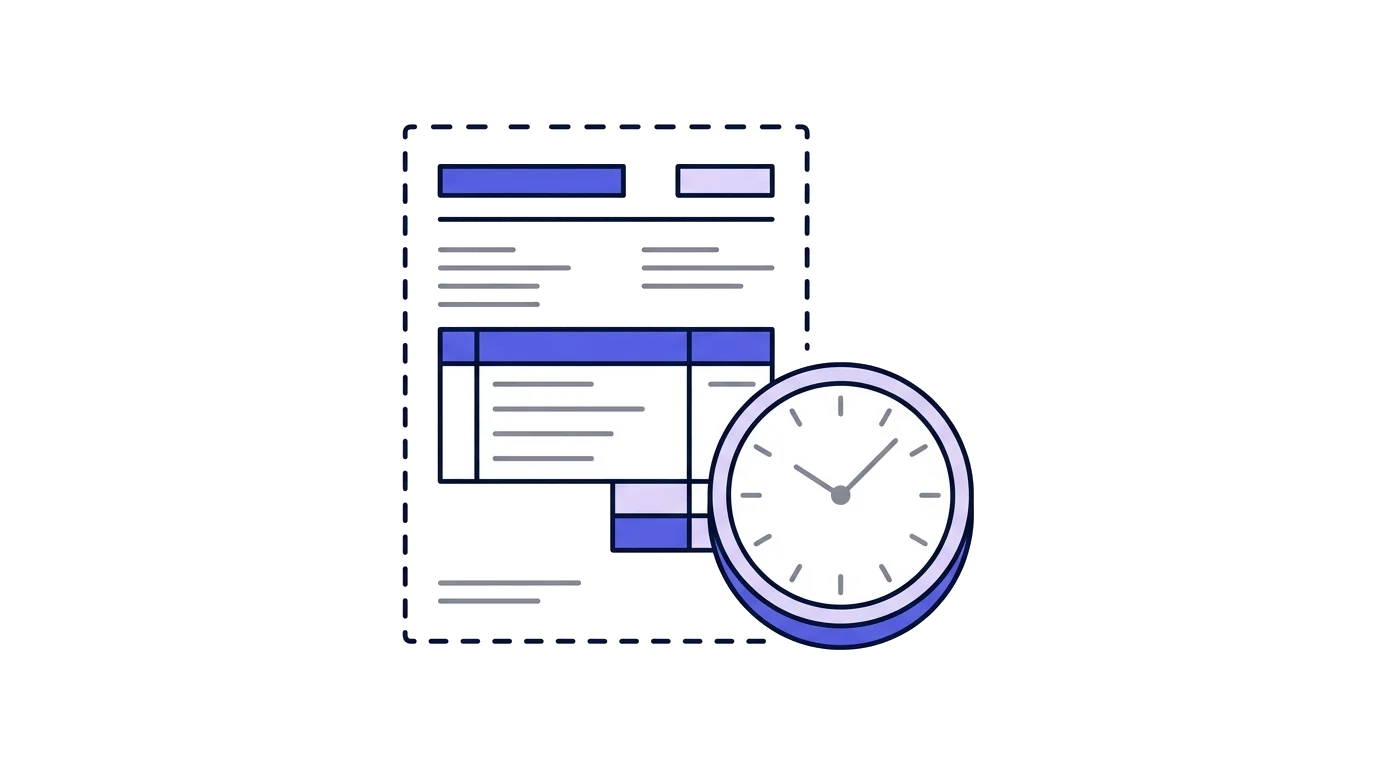
The transaction invoice causes more confusion than any other document in an Israeli business. It looks like a tax invoice, it carries an amount and VAT, and it reaches the customer the same way. As far as the Tax Authority is concerned it does something else entirely: it asks for money, and nothing beyond that.
- Requests payment for a transaction done or about to be done
- Gives the customer no input VAT deduction
- Needs no allocation number
- Can be cancelled without a credit note
- Records the transaction for VAT purposes
- Lets the customer deduct input VAT
- Needs an allocation number above the threshold
- Cancelled only through a credit note
What the document actually does
Section 45 of the VAT Law requires a business to issue a transaction invoice for every transaction or part of one, including transactions that are exempt from tax. The document records what was sold, to whom, for how much, and on what payment terms. It is a proper commercial statement, and it is entirely sufficient for asking a customer to pay.
What it does not do matters just as much. A transaction invoice is not a document that lets the customer deduct input VAT. A customer who is an osek murshe will receive it, pay against it, and then ask for a tax invoice so the VAT can be offset in their own report. Without that tax invoice, the VAT they paid stays a cost on their books.
Why businesses choose to issue one
Cash flow is the main reason. A business on the accrual basis issues the tax invoice with the transaction, so one that issues at the start of the month and gets paid on net 60 terms hands the VAT to the Tax Authority two months before the cash lands.
The transaction invoice solves exactly that. You send it as a request for payment, wait for the money, and issue the tax invoice once the payment is in. The customer has a legitimate document to pay against, and the business is not financing the VAT out of pocket.
When the tax liability arises
The rule depends on the type of activity. For the sale of goods the liability arises on delivery to the buyer, under section 22 of the law. A business whose turnover does not exceed two million shekels reports the sale of goods on a cash basis, meaning on receipt of consideration and on the amount actually received.
For services the general rule in section 24 is when the service is given, but section 29 takes most service providers out of it: anyone whose turnover in the preceding year did not exceed 15 million shekels is charged on receipt of consideration and on the amount received. For most freelancers and small businesses, in other words, the cash basis is the default rather than the exception.
The practical conclusion: if you report on a cash basis, you can comfortably use a transaction invoice as your request for payment and issue the tax invoice when the money arrives. If you report on an accrual basis, check with your accountant exactly when the liability arises for you, because delaying the tax invoice does not necessarily delay the liability.
The transaction invoice for an osek patur
An osek patur may not issue a tax invoice and does not charge VAT. Their mandatory document is the receipt, issued for every payment that comes in.
The transaction invoice enters the picture when the income has not yet been received. It serves as a request for payment and as an orderly record of the income in the books. The amount shown is the full amount with no separate VAT line, and the document should state clearly that the issuer is an osek patur. A business customer will then understand immediately why there is no VAT to deduct.
That is also why many systems present the transaction invoice as the default document for an osek patur. The choice is a sound one, but it is an operational choice, and the document that closes the loop for an osek patur is the receipt.
Transaction invoice, payment request, price quote
The three terms get used interchangeably, and the gap between them is practical.
A price quote is a pre-transaction document. It proposes terms, it carries no binding force until the customer accepts, and it can be edited or deleted freely.
A payment request is a general name for any document asking for money. In practice, when an Israeli business says "payment request" it usually means a transaction invoice.
A transaction invoice is the orderly version of that request: a numbered document, recording a transaction that has already been agreed, and kept in the books. It is the document to send when the work is finished and the payment has not arrived.
Does it need an allocation number
No. The allocation number requirement applies to tax invoices only, never to transaction invoices, no matter how far above the threshold the amount sits.
The logic is simple. The allocation number exists to verify invoices that enable an input VAT deduction, because that is where the risk of fictitious invoices lives. A transaction invoice enables no deduction, so there is nothing to verify.
In practice this means you can send a transaction invoice for 80,000 shekels without contacting the Tax Authority at all. The moment the payment arrives and the tax invoice is issued, the allocation request becomes necessary, and that is the step that can delay or approve the document. Worth accounting for when a customer is waiting on paperwork for their own reporting.
What the document has to show
It has to carry the heading "transaction invoice" clearly, not just "invoice". Alongside that: the business name and business number, the customer's details, the date, a serial number from this document type's own sequence, an itemized list of goods or services, and the amount.
For an osek murshe the document will usually show the pre-VAT amount, the VAT, and the total, so the customer knows what to pay. Showing the VAT breakdown does not turn it into a tax invoice, and that distinction rests on the heading and on the nature of the document. For an osek patur a single amount is shown.
A document produced by a computerized system has to be digitally signed to be valid, and that applies to transaction invoices too.
Numbering, cancellation, correction
Every document type keeps its own numbering sequence. Transaction invoice number 15 and tax invoice number 15 can coexist without conflict, because each type runs its own counter.
A transaction invoice cancelled before a tax invoice was issued against it does not require a credit note, because no output VAT was ever reported on it. The number still cannot be removed from the sequence. Mark the document as cancelled and keep it, so the sequence stays intact in an audit.
Once a tax invoice has been issued for the same transaction, the rules change. From that point every correction goes through a credit note, and the original transaction invoice is no longer the thing being corrected.
How it plays out on one project
A consultant, an osek murshe reporting bi-monthly, finishes a project on 3 September for 20,000 shekels before VAT. He sends a transaction invoice for 20,000 plus 3,600 shekels VAT, 23,600 in total, on net 45 terms.
Payment arrives on 20 October. That day he issues a tax invoice receipt recording both the transaction and the payment, and requests an allocation number because the amount is above the threshold.
The 3,600 shekels are reported as output VAT in the September and October periodic report. Had he issued the tax invoice back in September, the VAT would have landed in that same report, but without the cash in the bank. The VAT calculator breaks the amounts down either way.
The payment terms stated on a transaction invoice are more than commercial practice. The date by which you have to be paid is also set in law, and the detail is in the payment terms law guide.
Where it goes wrong
The first mistake is sending a transaction invoice to a customer who asked for a tax invoice. They will find out exactly when their bookkeeper closes the quarter, and it comes back to you as an urgent request.
The second is issuing another tax invoice after one was already issued for the transaction, on the assumption that the first document was "only a transaction invoice". The result is a double report.
The third is a vague heading. A document that just says "invoice" and shows a VAT breakdown reads to the customer as a tax invoice. If a transaction invoice was intended, the heading has to say so.
The fourth is leaving transaction invoices open with no follow-up. A document that requested payment and was never converted into a tax invoice is usually money that was never collected.
Transaction invoice to tax invoice without retyping
In Slate the transaction invoice is a full document type: its own numbering sequence, a digital signature, and tracking for documents that have not been paid. Once payment arrives you can convert it into a tax invoice or a tax invoice receipt without retyping the line items, and the link between the two documents is preserved. For an osek patur the system shows only the document types they are allowed to issue, so a tax invoice cannot be created by mistake.
This is general information, not tax advice. For a specific situation, talk to an accountant or tax adviser.
A sample transaction invoice shows what it does print, and what it is missing next to a tax invoice.
Common questions
What is a transaction invoice?
A document recording a sale or a payment request before payment arrives. It gives the customer no input-VAT deduction, so it is not a substitute for a tax invoice.
Does a transaction invoice trigger VAT?
Not by itself. For a business reporting on a cash basis, VAT arises on receipt of payment, so a transaction invoice lets you send a payment request without bringing the VAT forward.
Does a transaction invoice need an allocation number?
No, at any amount. The requirement applies to tax invoices only, because the allocation number exists to verify a document that enables an input-VAT deduction.
How does it differ from a quote?
A quote is an offer you can walk back; a transaction invoice is a payment request on a sale already agreed. Neither is a fiscal document for VAT purposes.
Can a transaction invoice be cancelled?
Yes, with no credit note. It creates no VAT liability and grants no deduction, so cancelling it is far simpler than cancelling a tax invoice.
When do you convert it into a tax invoice?
When payment arrives, or when the reporting obligation arises under your reporting basis. Convert from the existing document so the link between the two is preserved.