
A common mistake among new freelancers is assuming there's one "correct" document for every transaction. In practice, the right document type depends both on your business status and on whether payment has already been received.
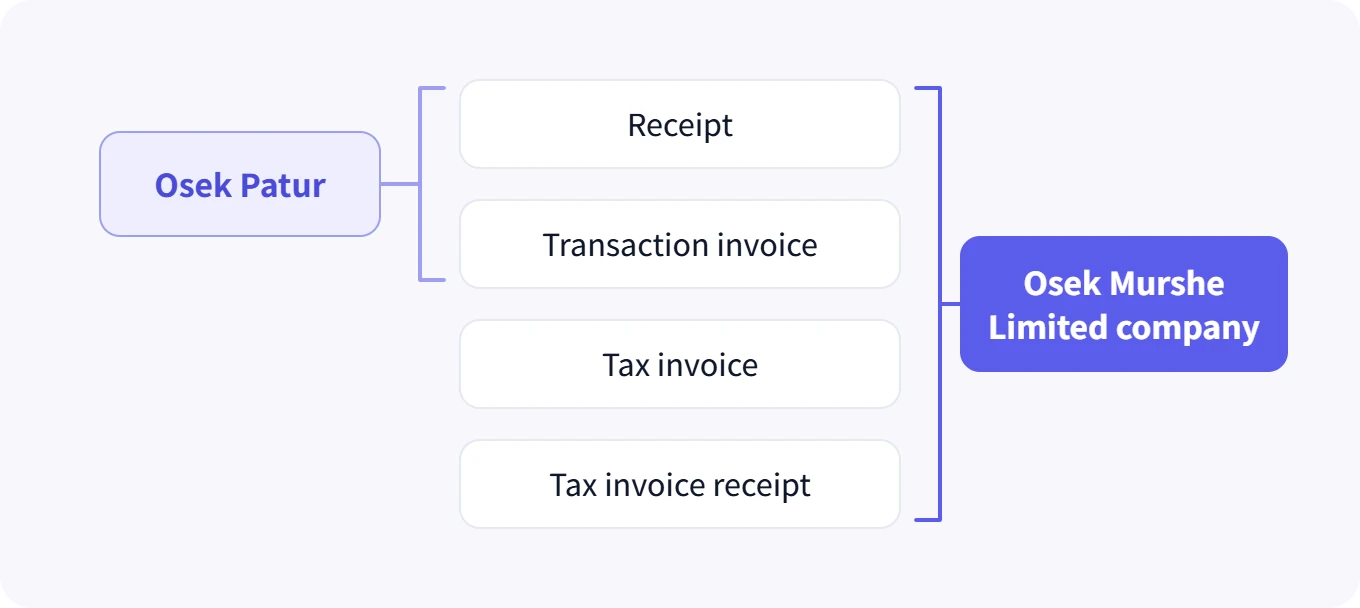
- Who is issuingAn osek patur issues a transaction invoice, an osek murshe issues a tax invoice
- Has payment arrivedIf it has not, you issue the invoice on its own
- Payment arrived at the same momentAn osek murshe issues a tax invoice receipt, an osek patur issues a transaction invoice and a receipt
Transaction invoice
Documents a transaction (a sale or a service provided) before payment, or regardless of whether payment has actually been received. An osek patur issues a transaction invoice instead of a tax invoice, since they aren't allowed to charge VAT.
An osek murshe can issue one too, usually as a request for payment before delivery. The substantive difference is that a transaction invoice doesn't entitle the customer to an input VAT deduction, so it's no substitute for a tax invoice.
When to use it, how it affects the timing of your VAT payment, and whether it needs an allocation number are covered in the transaction invoice guide.
Tax invoice
A document that only an osek murshe (licensed dealer), or a company, is allowed to issue. It documents a transaction that includes VAT, and it's the basis for the customer receiving it to deduct input VAT, which is why it's also subject to the allocation-number requirement above a certain threshold.
It's the only document on this list that creates direct monetary value on the other side. That's also why it's the one that gets scrutinized. Its issuing deadlines and required fields are set out in the osek murshe invoice guide.
Receipt
Documents a payment actually received, whether for a transaction already documented by a transaction invoice or tax invoice, or as an advance payment. A receipt alone isn't sufficient documentation for a transaction by an osek murshe; it always accompanies a tax invoice.
A receipt also states the payment instrument: cash, a cheque with its number and bank, a card with the last four digits, or a bank transfer. That detail isn't decoration, it's part of the required record. Partial payments, tax withheld at source and cancelling a receipt are covered in the digital receipt guide.
Tax invoice receipt
A combined document that records both the transaction and the receipt of payment at the same moment, useful when payment arrives immediately alongside the service (paying by credit card at the end of a meeting, for example). Issued by an osek murshe only.
The edge cases, such as a post-dated cheque, card instalments or an advance payment, are covered in the tax invoice receipt guide.
Quick decision table
| Situation | Osek patur | Osek murshe |
|---|---|---|
| Sale, payment to follow later | Transaction invoice | Tax invoice |
| Payment received at the same moment | Transaction invoice + receipt, or receipt alone if a transaction invoice was already issued | Tax invoice receipt |
| Advance payment toward a future transaction | Receipt | Receipt |
Documents that aren't fiscal documents
Alongside those four sit documents that look similar but aren't fiscal documents, so they don't enter the sequential numbering and aren't reported.
A quote is a commercial document only. It triggers no reporting, carries no VAT to report, and can be revised or withdrawn freely.
A delivery note records goods handed over, separately from billing. It's needed wherever physical supply is involved, and is often issued before the invoice itself.
The distinction matters because it decides what can still be corrected. A quote can be deleted; a tax invoice cannot, and every correction goes through a credit note.
The exact list of fields required on each of these documents is collected in the document templates guide. Anyone issuing to an overseas client will find what changes, including language, currency and zero-rated VAT, in the English and foreign currency invoicing guide.
What each document has to carry
A tax invoice has to state the words "tax invoice", the business name and number, the customer's details, the document number, the date, a description of the sale, the amount before VAT, the VAT rate and amount, and the total. Above the threshold it also carries an allocation number.
A receipt has to state the amount received and the payment instrument in detail: cheque number and bank, the last four digits of a card, or the transfer details. A transaction invoice has to be labelled as one explicitly, so the customer does not mistake it for a document that supports a deduction.
A recurring mistake among people issuing from Word: a heading that says "invoice" without the word "tax". That is not a wording nicety, it is what determines what the document is.
Why getting this right matters
Issuing the wrong type of document can get it rejected by the Tax Authority, stop your customer (especially an osek murshe buying from you) from being able to deduct VAT, and complicate reconciliation with the annual report.
Numbering must stay sequential within each document type separately. You can't "skip" a number even if it turns out the wrong document type was issued. In practice that means each document type runs its own counter, and two documents of different types can carry the same number with no conflict.
What to do when the wrong type was issued
If a tax invoice went out where a transaction invoice belonged, or the other way round, you can't simply delete it. You issue a credit note cancelling the wrong document, then issue the correct one. Both documents and the credit note between them are kept in full, under the retention duty.
Only the document types your business may issue
Slate only shows the document types relevant to the business status set in your business settings, so it's not possible to accidentally issue a tax invoice as an osek patur. Converting a transaction invoice into a tax invoice receipt, once payment comes in later, is done from the existing document and doesn't require retyping anything. The steps themselves are laid out on the page about creating invoices online.
This is general information, not tax advice. For a specific situation, talk to an accountant or tax adviser.
You can open a sample tax invoice and a sample receipt side by side and see the difference this guide describes.
Common questions
What is the difference between a tax invoice and a receipt?
A tax invoice records the sale and the VAT on it, and entitles the customer to deduct input VAT. A receipt records only that a payment came in. A sale carrying VAT needs a tax invoice, and a receipt alone is no substitute.
What is the difference between a transaction invoice and a tax invoice?
A transaction invoice is a payment request that gives the customer no input-VAT deduction, and it can be cancelled without a credit note. A tax invoice is a fiscal document that does give a deduction, and it cannot be deleted once issued.
Can an osek patur issue a tax invoice?
No. An exempt dealer may not issue a tax invoice. They issue a transaction invoice, and a receipt when payment arrives.
When do you issue a tax invoice receipt?
When the sale and the payment happen at the same moment, such as a card payment at the end of a meeting. The combined document records both, and it is available to a licensed dealer only.
What do you do if the wrong document type was issued?
You do not delete it. Issue a credit note cancelling the wrong document, then issue the right one. Both documents and the credit note between them are kept in full.
Does a quote have to be reported?
No. A quote and a delivery note are commercial documents, not fiscal ones: no VAT to report, no place in the sequential numbering, and they can be edited or deleted.